Cantina Laredo – Great Day – Sunny
Stories we tell ourselves
Lack of startups, meetings, community in this area – related to Cyber – Information Technology.
What I see: Courage
Courage isn’t the absence of network noise; it’s the decision that your signal\your plan\your actions matters more than the interference trying to drown it out.
Stories we conquer\Achieve with all effort
Questions that resonate with me – How do we share data and create a new social network that replaces LinkedIn and create trust and serious connections?
How to avoid tampering of data and fingerprinting from all those platforms?
How to make sure the documents, articles, RFQ, RFPs are legit, and we can find similar requests\fields over the internet on State, County, Federal and Private organizations?
Stories we Want for ourselves
A better Community
A better way to find similar people to grow
A better way to implement better ideas
What resonate with me after our talk:
Don’t stay just on your Sandbox. Engineer to handle the load of a live environment.
2)Second part of the brainstorming
Technologies that I research to learn what the market has for this project
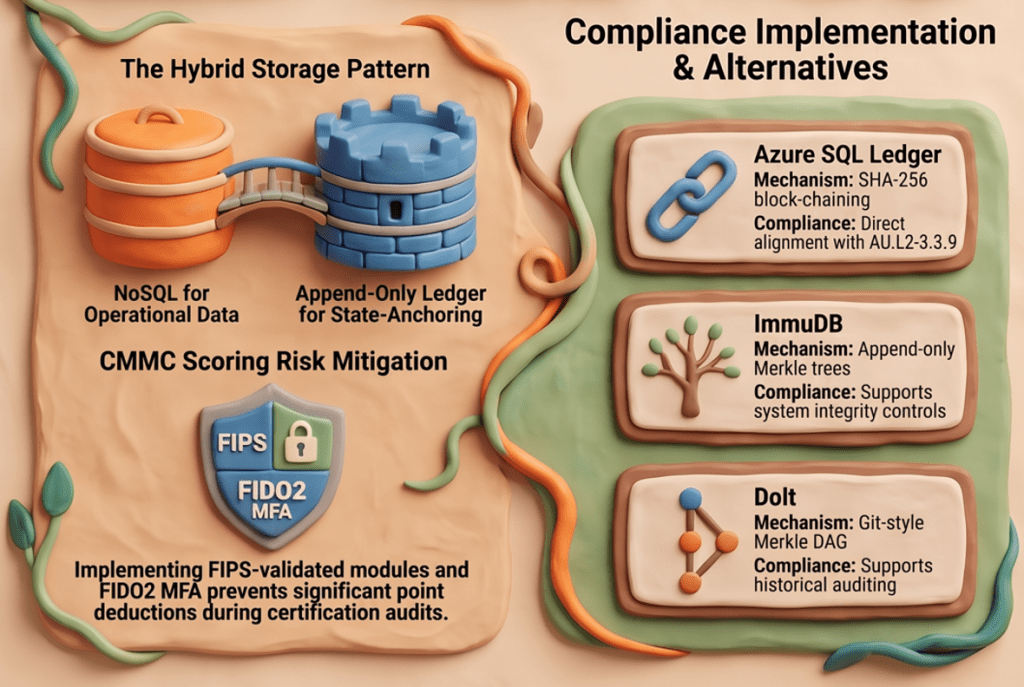
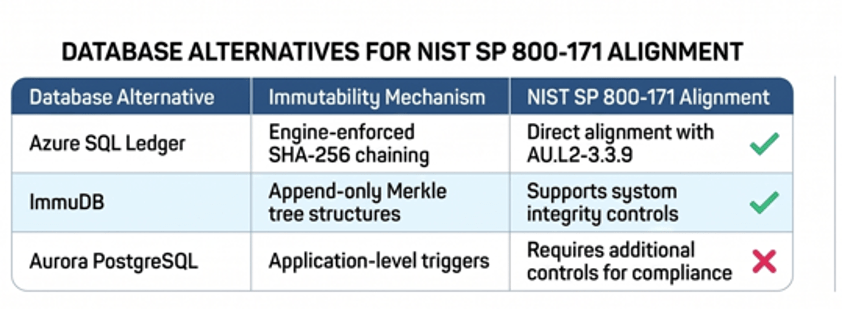
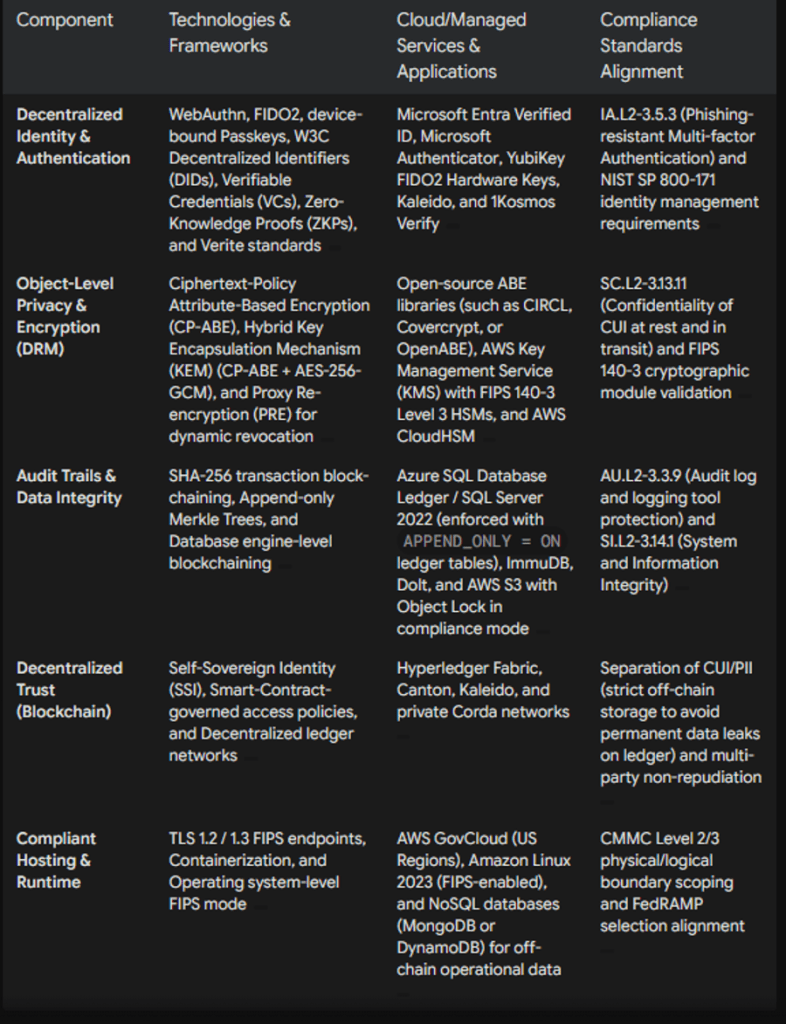
Compliance – NIST SP 800-171 Rev. 3
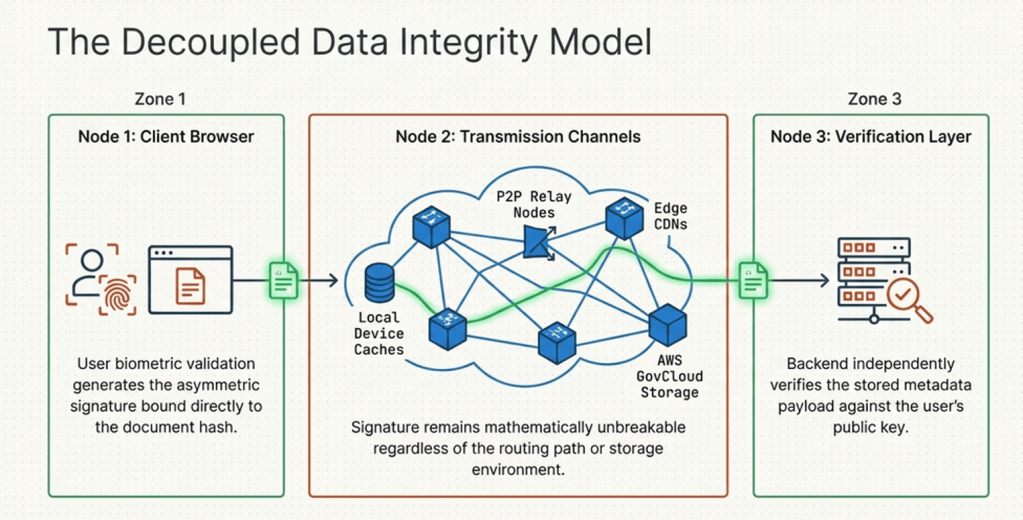
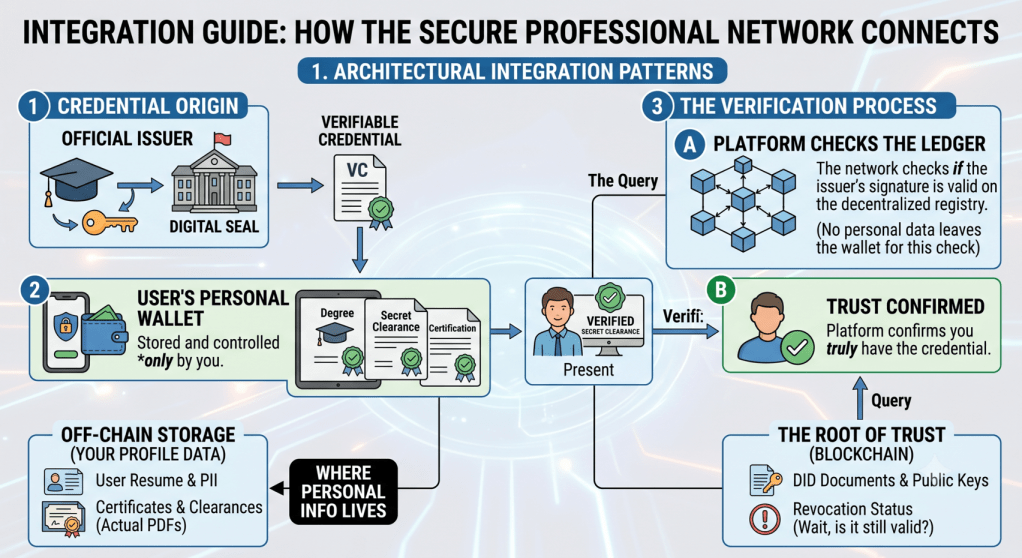
Decentralized identity & Authentication
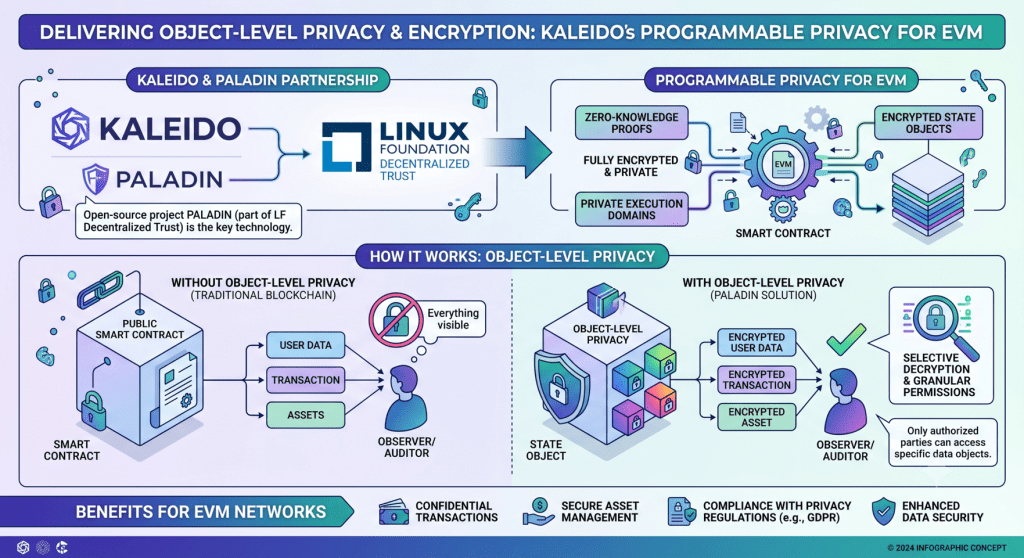
https://www.kaleido.io/product/permissioned-chains
They seem to deliver object-level privacy and encryption. Through their open-source project Paladin (now part of the Linux Foundation Decentralized Trust), they have implemented what they call programmable privacy for EVM.
References
1. Regulatory Frameworks & Compliance Standards
- NIST SP 800-171 Rev. 3
- Official Title: Protecting Controlled Unclassified Information in Nonfederal Systems and Organizations.
- Publisher: National Institute of Standards and Technology (NIST), U.S. Department of Commerce.
- Key Reference: Focuses on mapping system integrity and audit controls (e.g.,
AU.L2-3.3.9for audit log protection and cryptographic verification).
- CMMC 2.0 (Cybersecurity Maturity Model Certification)
- Official Title: Cybersecurity Maturity Model Certification (CMMC) Program.
- Publisher: Office of the Under Secretary of Defense for Acquisition and Sustainment (OUSD(A&S)).
- Key Reference: Levels 2 and 3 scoping rules requiring FIPS-validated cryptographic modules and phishing-resistant multi-factor authentication (MFA) to prevent point deductions during third-party assessments (C3PAO).
- FIPS PUB 140-3
- Official Title: Security Requirements for Cryptographic Modules.
- Publisher: National Institute of Standards and Technology (NIST).
- Key Reference: Standardizes physical and logical security bounds for hardware/software cryptographic modules deployed within cloud infrastructures like AWS GovCloud and Microsoft Entra.
2. Decentralized Identity & Authentication Protocols
- W3C Decentralized Identifiers (DIDs) v1.0
- Official Title: Core Data Model, Architecture, and Syntaxes.
- Publisher: World Wide Web Consortium (W3C) Recommendation.
- Key Reference: Establishes verifiable, decentralized digital identities decoupled from centralized registries or social media platforms.
- W3C Verifiable Credentials Data Model v2.0
- Official Title: Expressing Verifiable Claims and Credentials on the Web.
- Publisher: World Wide Web Consortium (W3C).
- Key Reference: Defines the architecture for digital wallets containing tamper-evident institutional attestations (e.g., security clearances, university degrees) with mathematical non-repudiation.
- FIDO2 / WebAuthn Specifications
- Official Title: Web Authentication (WebAuthn): An API for accessing Public Key Cryptography Credentials.
- Publisher: W3C & FIDO Alliance.
- Key Reference: Hardware-bound passkey protocols utilizing asymmetric signatures directly mapped to user biometric gates to eliminate credential harvesting and phishing vectors.
3. Cryptographic Privacy & Advanced Encryption
- Ciphertext-Policy Attribute-Based Encryption (CP-ABE)
- Foundational Literature: Bethencourt, J., Sahai, A., & Waters, B. (2007). Ciphertext-Policy Attribute-Based Encryption. IEEE Symposium on Security and Privacy.
- Key Reference: Underpins object-level data protection and Digital Rights Management (DRM) where decryption keys are bound to user attributes rather than static identities.
- Zero-Knowledge Proofs (ZKPs)
- Foundational Literature: Goldwasser, S., Micali, S., & Rackoff, C. (1989). The Knowledge Complexity of Interactive Proof Systems. SIAM Journal on Computing.
- Key Reference: Cryptographic primitives allowing users to present professional claims (e.g., active Secret Clearance) without exposing the underlying PII or registry data.
4. Immutable Ledgers & Data Integrity Engines
- Azure SQL Database Ledger
- Technical Documentation: Ledger Architecture and Overview. Microsoft Learn.
- Key Reference: Relational database engine enforcing tamper-evidence through SHA-256 block-chaining, transforming standard database tables into append-only cryptographic records.
- immudb
- Technical Whitepaper: immudb: The Open Source Immutable Database. Codenotary Inc.
- Key Reference: Lightweight, high-throughput database engine architecture executing cryptographic verification via append-only Merkle tree structures.
- Dolt
- Technical Documentation: Dolt: It’s Git for Data. DoltHub Inc.
- Key Reference: Relational database variant built on a Content-Addressable Merkle Directed Acyclic Graph (DAG), enabling continuous time-travel debugging, historical auditing, and branching/merging state logs.
5. Enterprise Decentralized Trust Frameworks
- Project Paladin (Linux Foundation Decentralized Trust)
- Project Context: Paladin Enterprise Privacy Framework. Linux Foundation (LF Decentralized Trust).
- Key Reference: An open-source, enterprise-grade programmable privacy framework built in partnership with Kaleido to enable confidential asset management, zero-knowledge states, and encrypted state objects over EVM networks.
- Hyperledger Fabric
- Technical Architecture: Androulaki, E., et al. (2018). Hyperledger Fabric: A Distributed Operating System for Permissioned Blockchains. Proceedings of the Thirteenth EuroSys Conference.
- Key Reference: Permissioned ledger framework that separates peer transaction execution from ordering services to support private data collections and object-level encryption boundaries.
 The Stubborn Cybersecurity Blueprint
Leave a comment